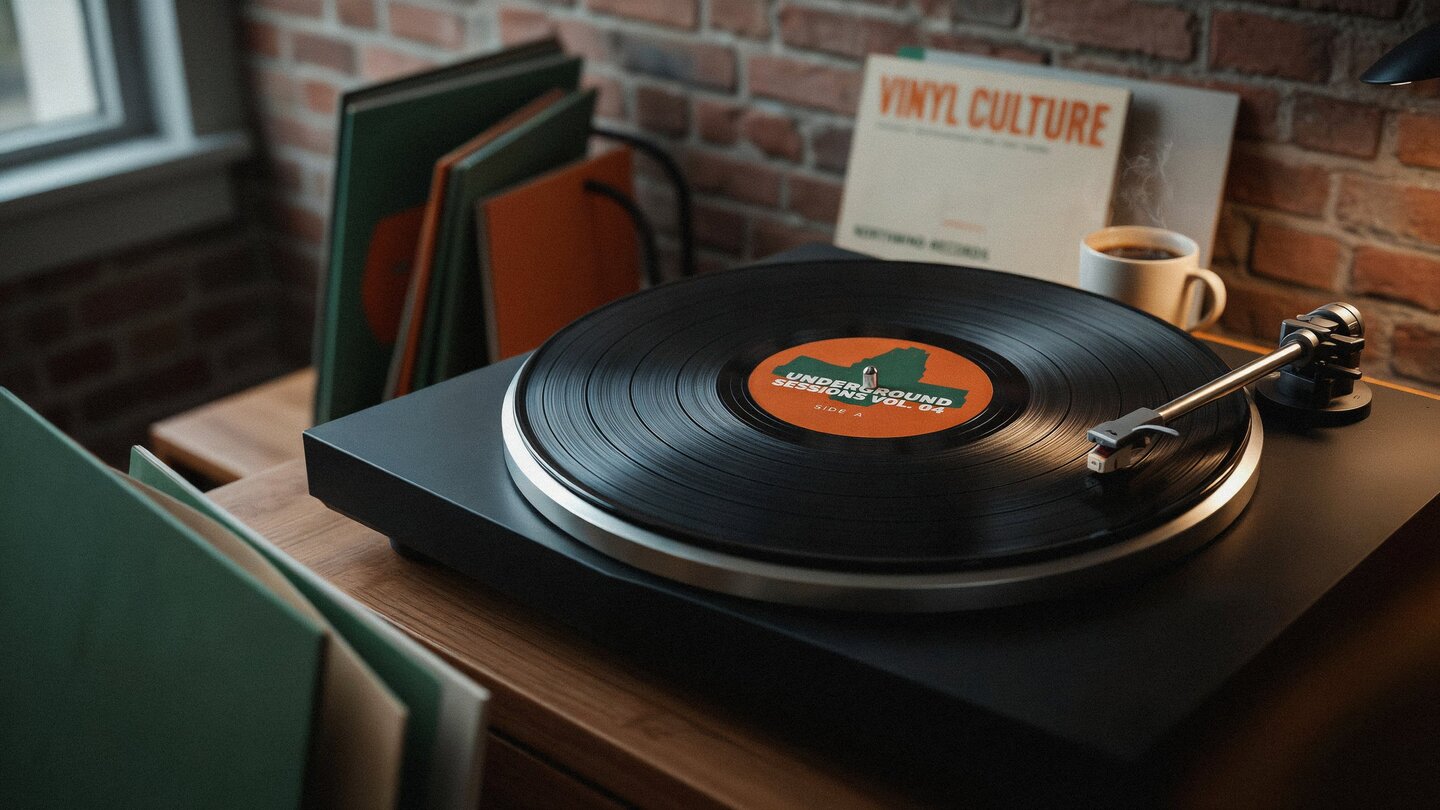
Media Concept
We help build an authoritative platform for vinyl collectors and underground music enthusiasts—one that doesn’t just report on releases but also cultivates a culture of mindful listening by uniting physical media with digital tools (APIs, databases). Our goal is to provide expert reviews and analytics on rare and new vinyl pressings, create a community where users can exchange opinions and find like-minded peers, integrate release data via APIs (Discogs, MusicBrainz) to build a comprehensive catalog, and establish editorial standards that exclude clickbait and superficial judgments.
Media Themes
Segment: music industry / hobbies and collecting. Narrow topic: «Vinyl as an Art Object and Investment: A Guide to Underground Electronic, Jazz, and Rock.» Justification for selection: The vinyl market has been growing for 15 consecutive years (Statista data). The audience is tired of algorithmic playlists and there is a demand for expertise and curated, «hand-picked» selections. This narrow topic allows us to avoid competition with giants like Pitchfork and Rolling Stone and focus on deep analysis.
Half-Yearmatic Plan
Months 1–2: «Foundation» (Aesthetic Immersion)Focus: visuals, foundational knowledge, and attracting a broad audience.
Sections: «Macro View» (beautiful record videos), «Vinyl for Beginners» (guides), «History of a Label.»Months 3–4: «Expertise» (Practice and Analysis)Focus: valuable content for collectors and DJs, API integration.
Sections: «Press Review» (how to distinguish original from reissue), «DJ’s Kitchen» (set analysis), «Digital Catalog» (reviews of rare items with valuation).Months 5–6: «Community» (Engagement and UGC)Focus: user-generated content, subscriber stories, live meetups.
Sections: «My Find» (stories from subscribers), «Blind Test» (guess the record by sound), «Collector Interview.»
Content Samples
Formats: textual longreads (Zen/Telegram), visual posts (Telegram), video (YouTube/Reels), podcasts (Audio).
Tone of Voice: passionate, expert, non-snobbish, detail-oriented.
Visual Style: macro photography, warm lighting, contrasting cover colors.
Content #1: Telegram Post (Text + Visual)Section: «Macro View»
Visual: A macro photo of a needle touching a vinyl groove.
Text:Did you know that the sound on vinyl isn’t just a «warm tube» stamp? It’s physics. The needle reads the micro-vibrations of the groove, which were carved there by a lathe.
Today in the #MacroView section, we look at what the music we love actually looks like.
P. S. The photo features a 1972 pressing that still sounds cleaner than many modern digital remasters.
Photo Example
Content #2: YouTube Shorts / Reels (Video Script)Type: Video (Vertical)
Category: «Blind Test»
Script (15 seconds):Shot 1 (0–3 sec): Close-up. A hand in a black glove places a needle onto a record. Sound: vinyl crackle (ASMR).Shot 2 (3–7 sec): Quick cuts. Record cover, close-up of the tracklist.Shot 3 (7–12 sec): On-screen text: «Guess the release? Original 1978 or 2023 reissue?» (a fragment of the track plays).Shot 4 (12–15 sec): Host (or text): «Write your answer in the comments! Full breakdown in the next video.»
Vinyl Fragment
Content #3: Dzen Article (Longread)Type: Text + Illustrations
Category: «Media Analysis»
Title: «How to Distinguish Japanese Pressing from European: 5 Signs That Don’t Lie»
Text (excerpt):Japanese releases are valued for the quality of the vinyl and the printing. But how do you avoid buying a counterfeit?OBI strip. If it’s present but printed on cheap paper—it’s a reissue. Original OBIs have a dense texture.Record weight. The Japanese frequently used heavier vinyl (140g versus 120g for European pressings).Cover seam. On originals, the seam often has an «overlap, ” whereas reissues have a flush seam. A complete guide with photos is in our channel.
Content #4: Podcast (Audio Script)Type: audio
Category: «Vinyl as Art»
Episode Title: «Why Does Colored Vinyl Sound Worse Than Black?»
Transcript (Excerpt):[Sound: vinyl crackle]
Host: Hello, this is VINYL.GROOVE. Today, we’re busting the myth that colored vinyl is just marketing. In reality, adding pigments alters the PVC structure. This can impact high frequencies. We spoke with an engineer from the Gramzapis factory and found out why audiophiles only buy black records. Spoiler: it’s not about the color—it’s about the chemistry.
Content #5: Telegram Post (Interactive)Type: Text + Image (Collage)
Category: «Subscriber Find»
Visual: Photo of a record found at a flea market, alongside a dusty envelope.
Text:«Found this at the flea market for 300 rubles. Thought it was trash, but when I put it at home—it’s an original 1978 promotional press!» — writes our subscriber Artem.
We love these kinds of stories. Send us your finds to the @vinyl_groove_bot bot using the tag #MyFind. We will publish the best stories and analyze their rarity using the Discogs API.
P. S. Artem, we checked: the price for a disc in perfect condition is 12,000 rubles!
«Subscriber Discovery»
Content #6: Video Review (Script)Type: Video (Horizontal, YouTube)
Series: «Digital Catalog»
Script (3 minutes):1. Intro (0:00–0:30)
Visual: Host sits at a table against a background of record shelves, holding an envelope.Text (Voiceover): «Today we’re examining a release considered the holy grail of the underground—Darkthrone’s A Blaze in the Northern Sky. We’ll find out why the original commands a ten-fold higher price than the reissue.»2. Main Body (0:30–2:00)
Visual: Close-up of the cover, turning the envelope, macro shot of the matrix (vinyl etching).Text (Voiceover): «Look closely at the matrix. If you see the MPO etching, it’s a French pressing. It sounds decent, but it’s valued less than the original from Norway. The authentic Norwegian pressing has a different weight and cardboard density.»3. Finale (2:00–3:00)
Visual: Host picks up a phone, opens an application, and scans the barcode on the cover. A graph and figures appear on the smartphone screen.Text (Voiceover): «Our API shows that this copy sold at auction for $1500. But don’t rush to buy—we’ll teach you how to distinguish a true rare piece from just an expensive record. Subscribe so you don’t miss the full guide on this vinyl.»
Example video
Content #7: Telegram Post (Announcement)Type: Text + GIF (Record Spinning Animation)
Category: «DJ’s Kitchen»
Text:This Friday, we’re dropping a deep dive into a set by a resident of the «Mutabor» club.
We slowed his set down by 30% to dissect how he transitions between tracks. This isn’t just about «mixing two songs»; it’s mathematics.
Ready to learn how perfect groove emerges from underground chaos? Drop a 🔥 if you’re excited!
Content #8: Guide Article (Text)Type: Text + Infographic
Category: «Vinyl for Beginners»
Headline: «How to Choose a Turntable When You Don’t Have 100,000 Rubles»
Text:We have compiled 3 budget models (under 25,000 Rubles) that won’t ruin your records. The golden rule: Never buy «suitcase» models with ceramic cartridges. They kill vinyl. The article includes a comparison chart (tonearm weight, drive type, presence of built-in phono correction) and setup tips.
Content #9: Interview (Text + Photo)Type: Long Read
Category: «Interview with a Collector»
Headline: «The Archive That Doesn’t Sell: The Story of the Owner of 5,000 Vinyl Records»
Text (Excerpt):«When I started collecting vinyl in the 90s, I never thought it would become an investment. I was simply looking for things that weren’t available on cassette tapes, ” says Dmitry, owner of the underground archive.
We spoke with him about how he stores the collection (in specialized containers at 40% humidity), which releases he is still searching for, and why he has refused to sell his archive for 3 million rubles.
Content #10: Audio Podcast (Special Edition)Type: Audio
Category: «Press Analysis»
Episode Title: «Silent Sound: How to Spot a Record with Worn Grooves»
Script:[Sound: needle drops onto vinyl]
Host: Do you hear that noise? That’s not dust. That’s wear. Today, we learn to listen for defects.Listen to the pause between tracks. If you hear «sand» there—the record has been played many times.Look at the reflections. If the groove is dull—it’s worn down.Check the center. If the hole is distorted—it means the record was frequently placed on a turntable with excessive force.
Take care of your treasures!