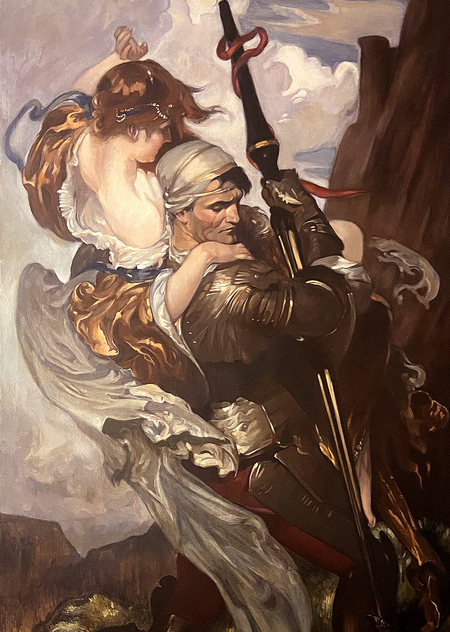
Diploma in professional retraining, S. G. Stroganov University of Art and Industry. 2021 One of the direct reasons for the study of copying painting as a way to improve your own skills is the relevance of the problem of combining «new» views on the natural nature of the artist with the skills of the world’s artists and artists. The link between «new» discoveries and «old» is sometimes not sufficiently clear, leaving the full substance of the subject to be known by experts. As an example, the current situation in which computer graphics, the most popular tool in recent years for creating images in a virtual environment, may not be sufficiently effective without an understanding of the basic principles common to all paintings, regardless of the medium or art media used. The main purpose of the study is to study the three — step method of copying painting, as illustrated by the work of Solomon Joseph Solomon, St. George.
The «three-step method» has been chosen as a technology for graduate work. This method of work was used in Michelangelo Caravajo’s time. In his book on painting, Solomon Joseph Solomon also speaks of the stage of the work. In writing the painting, using the color immediately, it contrasted the monochrome image with the Grisail, which allowed for a clear tone of the work. This way of working, in addition to giving history, did not lead to confusion in the variety of shades.
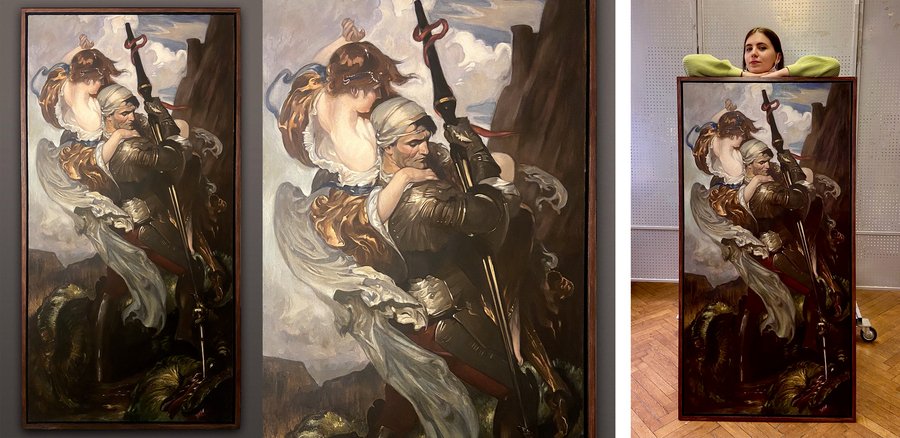
Ready work. 150×75 cm butter
Prior to the start of the direct work on the frame, the ground-wrapped canvas (construction: lazy and cotton) of the middle grain was selected to create a suitable texture, combining a volumed dragon with the rest of the figures. Despite the original grounding of the material, the canvas was further glued with gelatin in three layers and again covered on top with acrylic coloured soil (a mixture of white and oxen yellow). The coloured soil was created so that the base would already be warm before paint, allowing the light parts to shine organically. Three weeks were spent in order to better dry the ground, as inadequate drying could be a problem for the next step.
Then began the first stage, the imprimatation of the «vandiq» oil paint using pinenean. It has become the most important part of this work, given that some parts, as agreed in the course of the original analysis, may have remained at this stage before the foresting. The creation of a monochrome image helps not only to create a tone in the painting in general, which will then be supported by other stages, but also to clarify the composition in the sheet for the artist who is copying. This also proved to be the most difficult stage, given the large amount of detail that Solomon may have added to the top of the forest.
The second stage is «grisail» or «pupil». Starting with the brightest, the painting is filled with zinc blonds and vandals. Light parts of the sky and princess were the most difficult to write, given the structure of zinc bleach, titanium bleach was added to the density at the end of the phase, making it possible to achieve the necessary whiteness. The dragon was last written using lacquer and pinean, but even in this phase it was not too thick to leave the details upstairs after the forest was finished. The fact was added by brushes, mastikins, paint on the food film. When the main work on the underwear was finished, some parts had to be further lit in thin layers, such as the skin of characters and the sky.
Impressure + Grisail
The coloured stage is the foresting. The prepared tone base is mainly based on transparent, semi-translucent pigments, and the oil fluids were used in linen oil and pineapple to obtain the right easy application over the black and white image. In addition to whites and vandals, paint such as Mars (yellow, clear, brown, brown, dark), Indian yellow, siena, ultramarine, emerald paint, red (A), and film (mimulation) were used. The frame for the painting was made in brown shades to fit into the interior.