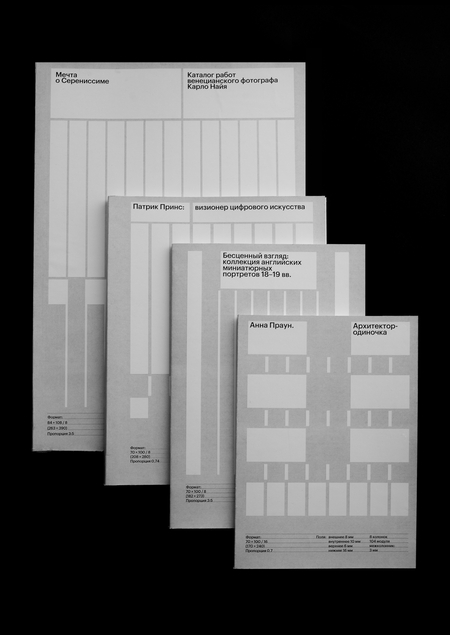
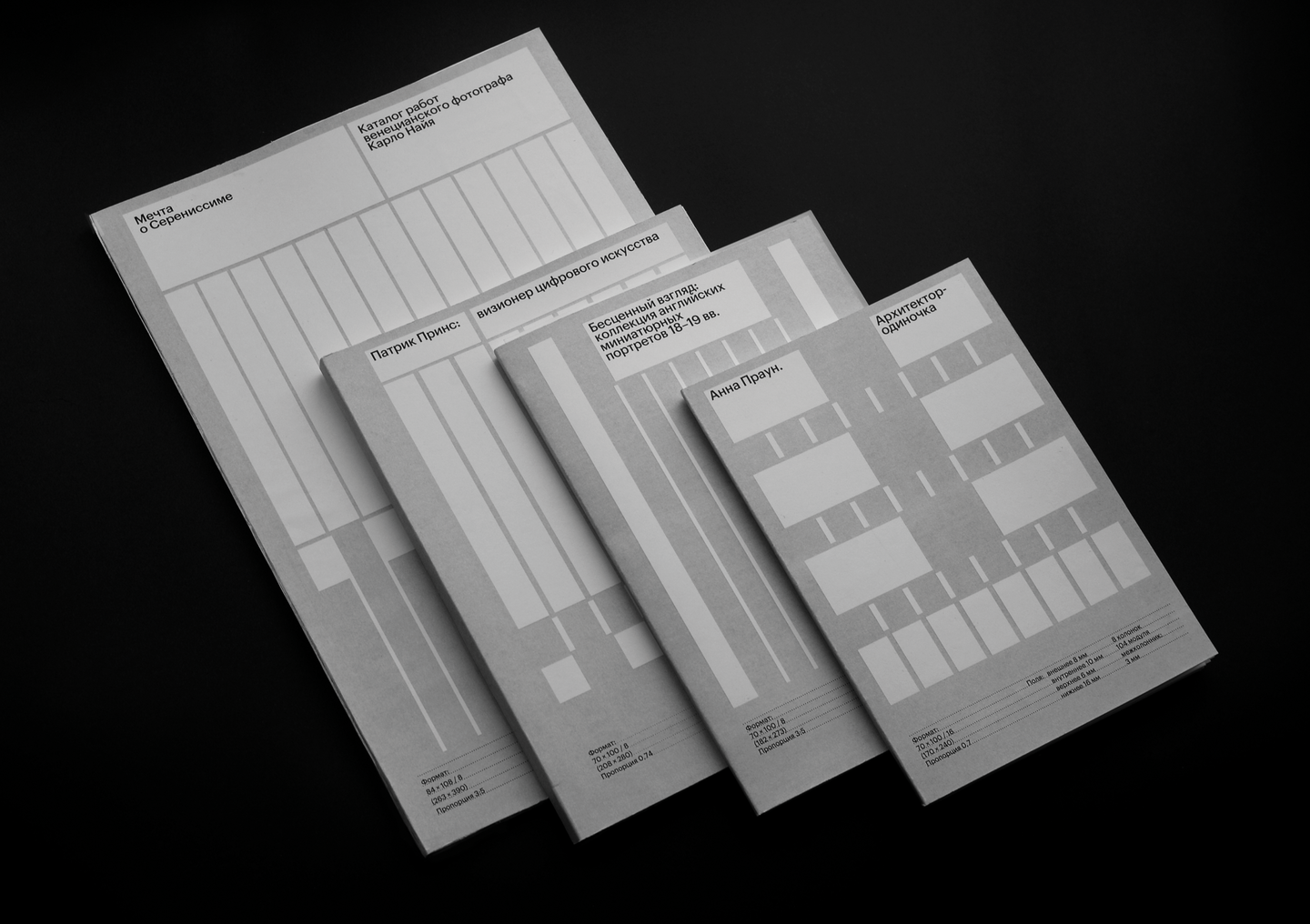
This series of catalogues is an annex to the a diplomatic paper < < < Methodological Manual for & bdqua; Basic Printings“».
The task of the catalogues — shows what competencies a student can have after a course. Among them are — not only the technical skills of wrinkle and work with many-page mock-ups, but and, more importantly, understanding the historical context of printing, the ability to navigate in styls and epochs, the argumentative explanation of their visual decisions, and the use of printing quotations from different styles and epochs is appropriate. So the theme of each catalogue is chosen to be related to some sort of printing style and era.
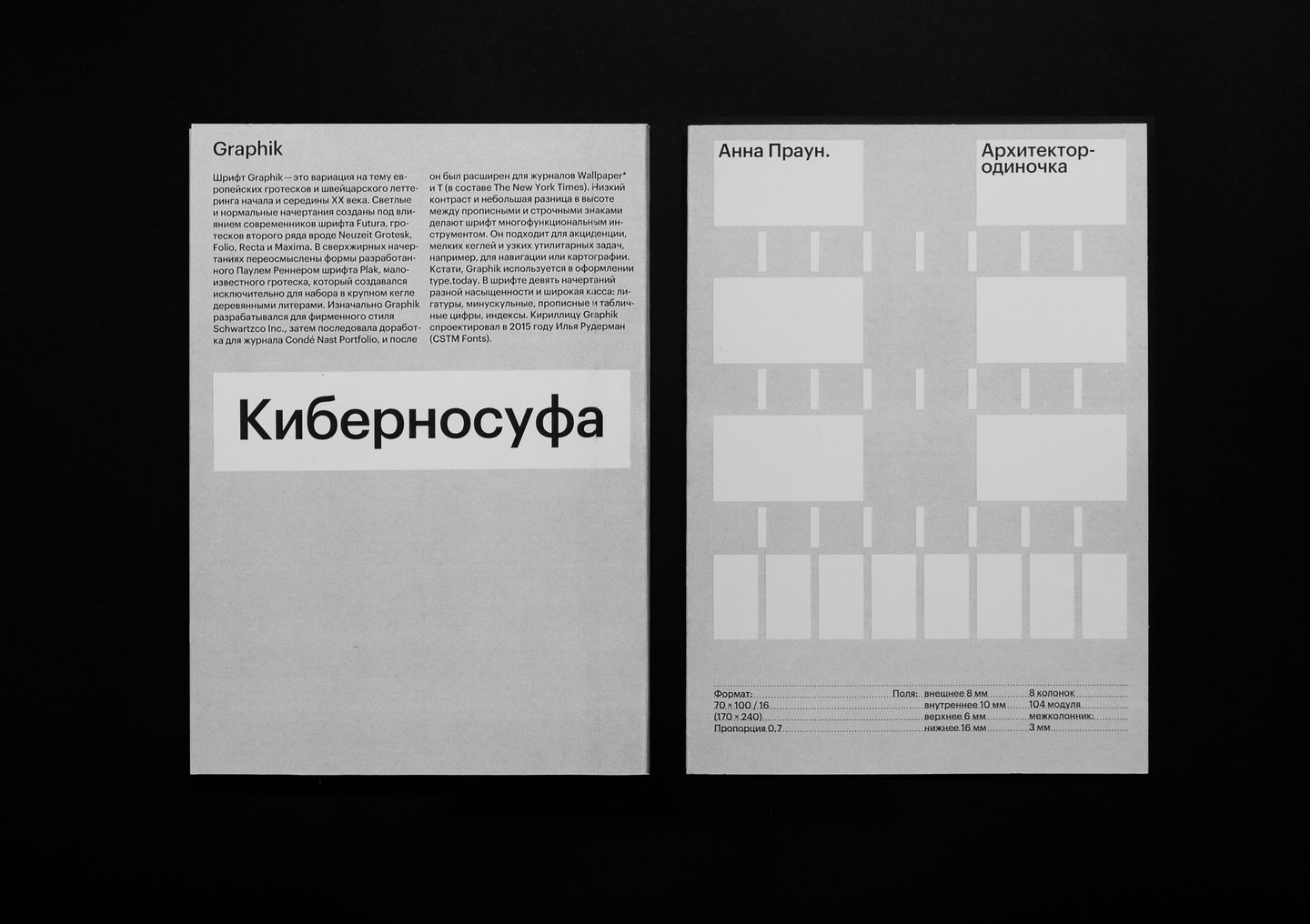
On the 4th side of the cover, all the catalogues have a charcteristics of the selected garrison.
The dream of Serenissim. Catalogue of the work of the Venetian photographer Carlo Naye.
The catalogue is dedicated to the creation of Carlo Naia (1813–1882), one of the leading Italian photographers of the 19th century whose works have had a significant impact on the visual image of Venice. The publication included photographs of a master from the Vienna Museum of Applied Arts (MAK), previously rarely shown and published. The catalogue suggests that Nay ' s work be considered from the perspective of three thematic areas, reflecting the diversity of its artistic and documentary practices.
Macket is based on the principles of classical printing adapted to modern book design: a combination of the Venetian and Minion 3 creates a historical reference to the Venetzian antiquities, providing a mild rhythm of recruitment and a visual connection to the epoch. Symmetrical twist composition and wide outer fields form « breathing» a page structure corresponding to the canons of traditional book architecture. The use of proscribed Minion 3 Display on schmuctils reinforces the sense of academicity and cultural continuity.
This catalogue is dedicated to the unique development of the late 18th&mdash English visual culture; early in the 19th century— eyeporters. As miniaturous images of one eye, these pieces occupy a special place between the intimate gift, the jewelry and the the psychological portrait. The catalogue is accompanied by richly illustrated reproductions from Victoria and Albert Museum, Birmingham Museum and Art Gallery, Philadelphia Museum of Art, and also includes modern interpretations of the genre in works by artist Fatima Roncillo, which preserves the spirit of mystery and camera image in the content of today ' s art language.
Maquet reconstructs the visual language of the English typographer of the Kaslon era, combining William Pro — modern interpretation of Caslon — with features for the time: double lines in headlines and quotations, vertically stretched with a set band with wide-ranging external and scrubbed fields that form ' uo; okno&racuo; for staring; images of the miniatural in the optical center of the strip, their « eyes&raquao; connected to the continuous visual line that turns a catalogue reading into consistent perceptive travel, where the printing is not&nb&ppppt;