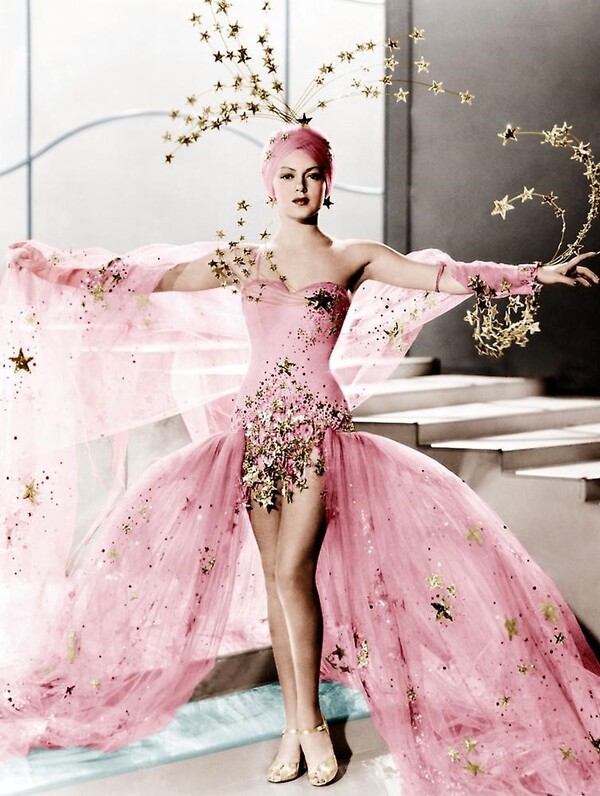
This material accompanies the audio lecture, «Feathers, Fruits, and Marshmallow: Spectacle in the Costume Design of 1920–40s Hollywood Films, ” which is part of the lecture audio project on the Lectr platform (formerly Storytel), based on a conference held by the HSE Art and Design School titled „Presenting the Unusual: Cognitive Dissonance, Pattern Disruption, and Other Fantastic Creatures.“ The cycle of audio lectures is curated by Lyudmila Alyabyeva. The audio lecture is available here. This is release 5 of 8.
Peacock feathers, butterflies, cobwebs, fruit compositions—all of these became sources of inspiration for Hollywood costume designers of classic Hollywood. What is the meaning behind such costumes? And why did extravagant looks reign on screen? How can one interpret such images?
The period from the 1920s to the 1940s represents a pivotal era in the history of cinema, encompassing entirely different types of production and narrative methods.
The twenties were still the era of silent film, where dialogue and any commentary on characters were conveyed through intertitles integrated into the film’s visuals. It is logical that it was during this period that particular attention was paid to the appearance of the film’s heroes, especially their costumes. In silent film, the characters' clothing communicates information about them on a non-verbal level—it tells the audience about their way of life, certain aspects of their personalities, what to expect from these characters, and their place within the plot. Often, the costume in silent film becomes the core of an actor’s persona. One need only recall the image of Chaplin’s «vagabond» or the persona of the French comedian Max Linder, whose tailcoat and top hat are firmly associated with his cinematic image.
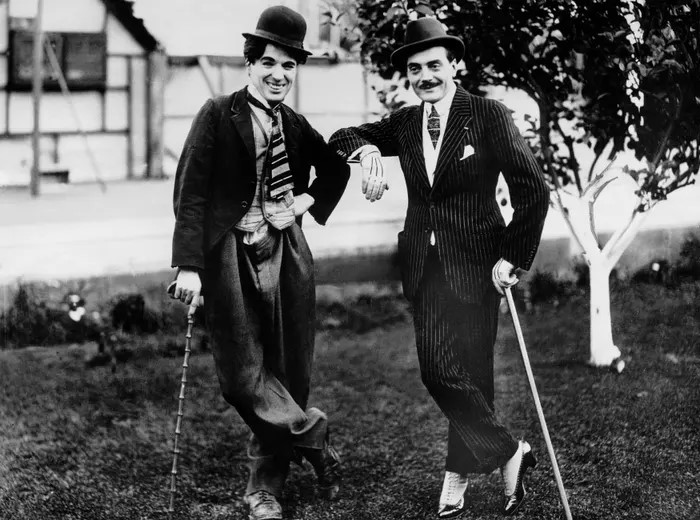
Charlie Chaplin (left) and Max Linder (right), second half of the 1910s.
Source: Keystone-France/Gamma-Keystone via Getty Images.
In the 1920s, Hollywood studio costume workshops flourished, and the designers who headed them gradually became celebrities not only in the world of cinema but also in American fashion. The relative freedom in interpreting movie characters' attire characteristic of the «Roaring Twenties» gave rise to a unique type of conceptual costume—one that was determined less by the plot of a specific film or the characters' psychology, and more by the goal of creating a spectacular image that harmonized with the film’s visual style.
Such striking, memorable, and unconventional costumes are not simply clothing worn by the characters. These costumes were specifically designed to attract attention, sometimes even overshadowing the hero.
A still from the film «The Golden Bed» (1925, directed by Cecil B. DeMille). Costume designers Claire West and Edith Head, Paramount studio. Source: cecilbdemille.com
The spectacular nature of costumes persists even after the advent of sound in cinema. The materials used to create these costumes change. Heavy dresses adorned with beads and sequins, which rustled during movement, proved too «noisy» for early sound recording equipment. Therefore, Hollywood costume designers during this period turned to quieter materials, such as ostrich and rhea feathers, fur, and silk and satin that draped along the body.
Fashion, of course, also played a role—short, dropped-waist dresses in the spirit of the 1920s gave way to feminine, form-fitting long gowns. Although sound recording technology developed quite rapidly and the material problem soon disappeared, feathers and fur became synonyms for Hollywood glamour in the 1930s—that unattainable, yet highly marketable dream.
Escapist films featuring lavish sets and opulent gowns during the difficult years of the Great Depression served as a solace for many viewers.
The so-called «Hays Code» also introduced its own adjustments to the ideals of Hollywood fashion. This was a measure of self-restraint for Hollywood studios, which, in the early days of sound cinema, were suffering financial losses due to numerous complaints from local municipal authorities and state governments, as well as religious communities dissatisfied with the high degree of provocation and violence on screen, and which demanded its censorship.
Scene from the musical episode «By the Waterfall» in the film Footlight Parade (1933, directed by Lloyd Bacon). Costume Designer Milo Anderson, Warner Bros. studio.
This set of regulations evolved into a form of self-censorship that organized all potential objections into a unified system. It also allowed for the easing of demands for an outright ban on indecent cinematic images—a ban that would have resulted in financial losses for most film studios that controlled the distribution of their movies. The Code initiated the gradual disappearance from screens of sheer fabrics, revealing costumes, low-cut garments, and scenes of partial or full nudity. What was easily visible in films from the early 2000s virtually vanished within just a few years. However, although the «code» eliminated directness, it simultaneously provoked a «game of innuendo,» which screenwriters, directors, and, of course, costume designers eventually mastered to perfection.
A still from the film «The Great Ziegfeld» (1936, directed by Robert Z. Leonard). Costume Designer Gilbert Adrian, MGM studio.
All of this, naturally, did not prevent extraordinary costumes from dominating the screen during this period. Exposed areas of the body can technically be covered with fortress-like tulle fabric, but the effect remains the same. The extraordinariness of individual costumes can also be expressed through symbolism and analogy. Even in the following decade, the 1940s—marked by the upheavals associated with war—extraordinary costumes, while moving to the background and giving way to more realistic onscreen attire, do not disappear entirely; bright and unimaginable costumes nevertheless persist.
A still from the film «Madam Satan» (1930, dir. Cecil B. DeMille). Costume designer Gilbert Adrian, MGM studio.
Extraordinary costumes function as a kind of visual spectacle, allowing the audience to experience what they see on screen on an almost sensory level. Even though decades have passed since then, beaded and feathered gowns, skeletal garment structures, whimsical headpiece decorations, and other exotic and provocative stylistic concepts in Hollywood costume design have inspired both the fashion designers of subsequent decades and entire future cultural phenomena.
A scene from the film «Ziegfeld Folles» (1944, dir. Vincent Minelli). Costume designer Helen Rose, MGM studio.