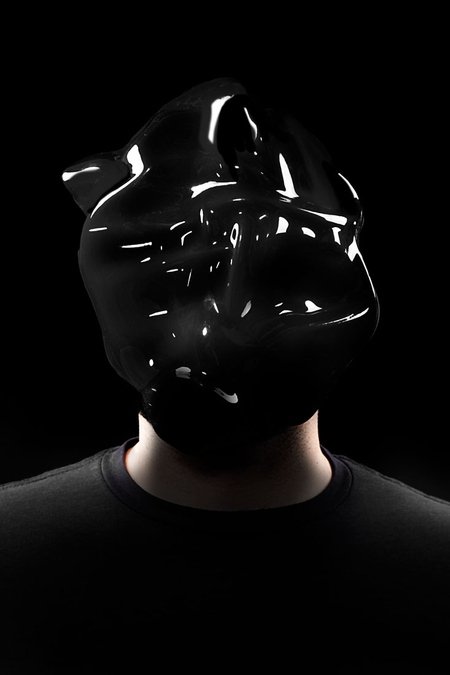
Today, facial recognition is becoming an integral part of the digital infrastructure, from surveillance cameras to social media filters. A person ceases to be only in this way: it becomes a biometric code, a data unit, a means of identification. This changes not only the attitude towards privacy, but also the perception of visual identity itself. Attention to these changes is increasingly reflected in artistic and design practices: through distortion, disguise, or direct interference with algorithmic perception.
The visual resistance to which the study relates is not limited to declarations; it is manifest in form. Artists develop makeup that confuses recognition, creates masks and digital patterns, and transmits an algorithmic look to the space of installation and performance. In these projects, a person becomes not just a topic, but a surface for action, an error in the system, an area of impossible recognition.
The study is based on visual material showing different approaches to dealing with the face, ranging from documentary images and screen shots to dramas, videos and clothing objects. All examples are selected in view of their visual uniqueness, so that each section opens up a new perspective. The first step is to look at the principles of algorithms and how they change the way people look at people. The focus is further shifted to artistic intervention: a person turned into camouflage or distortion. Selected chapters analyse design solutions that create «invisible» and initial work where surveillance becomes part of the action. The final question is why visual resistance is now becoming one of the key instruments for discussing power and identity.
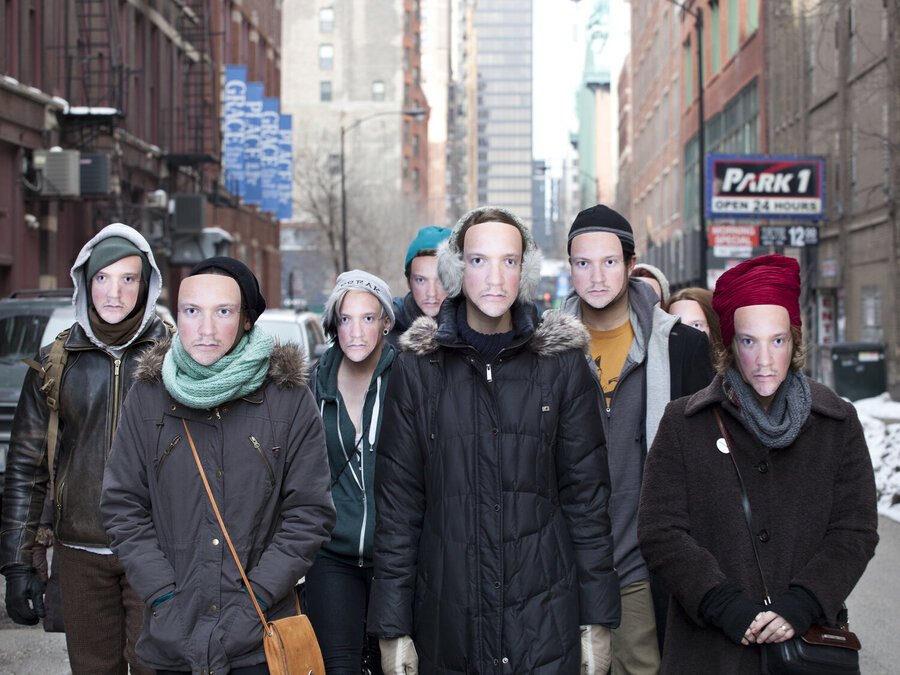
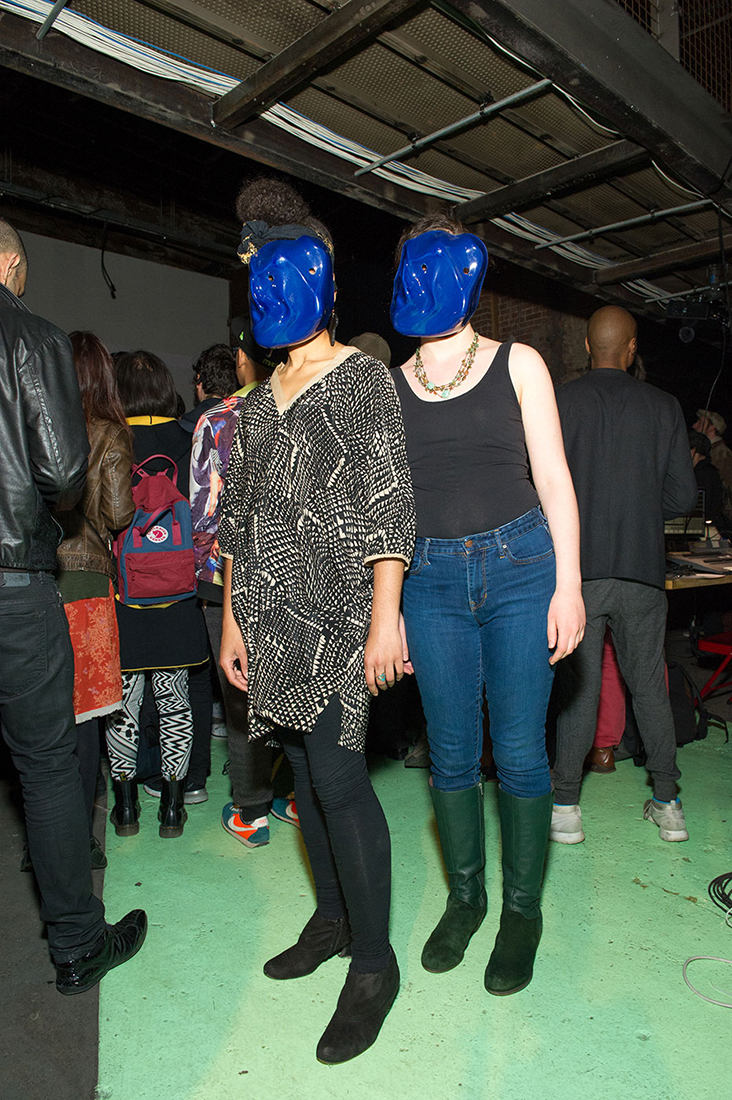
Leo Selvajo, masked men at the Modern Photo Museum, Chicago, 2020.
The analysis is based not only on visual observations, but also on texts related to observation theory, digital media and modern visual culture. The authors' own statements — how they formulate the objectives of their projects, describe their personal motives or interact with the audience — are also taken into account. By comparing images, contexts, and artistic gestures, there is a general shift in the understanding of the person, from an open image to a space of conflict, intervention, and refusal to be recognized.
The key issue in the study is how visual practices interfere with recognition systems and how they create an alternative perception of visibility, as well as the rights of their own person in the digital age.
(left-right) Zach Blas / Elle Mehrmand / micha cárdenas / Paul Mpagi Sepuya, installation and performance of Face Cages, 2015.
1. How machine vision works and what it does to face
Today’s technology sees the face not as a portrait, but as a structure. Machine vision defines key points — eyes, nose, chin lines — and turns them into a numerical pattern. This person is no longer an individual, but a vector that can be compared to millions of others in the database [3].
Google Vision API facial recognition tool
Algorithms are used in various fields: street surveillance, phone unlocking, marketing systems, police. At the same time, the process itself remains invisible — a person does not always know that he has already been recognized. There’s a new feeling about being seen not by someone, but by something.
«Engine learning systems are trained daily on such images — images taken from the Internet or public institutions without context or consent» by Kate Crawford. Atlas of Artificial Intelligence, p. 89 (2023) [4]
Algorithm errors are also significant. Systems are more likely to be wrong if the person is not white, not male, not average statistics. It’s not just bugs, it’s a reflection of built-in bias: models train on limited samples and reproduce social hierarchy [5].
Study of seven methods for thermal mapping of the face, 2013
Identification of faces is not only about identification, but also about power. It turns a face into a pass, an access filter, a statistical element. A person formerly associated with identity now becomes a digital identifier — out of context, out of human will. It is this attitude toward a person — as an object of analysis — that becomes the point of entry for artistic intervention. It is responded to by artists in an effort to destroy reading, make a failure, make a face unaffordable.
2. All right, all right, okay, okay, okay, okay, okay, okay, okay, okay, okay, okay, okay, okay, okay, okay, okay, okay, okay, okay, okay, okay, okay, okay, okay, okay, okay, okay, okay, okay, okay, okay, okay, okay, okay, okay, okay, okay, okay, okay, okay, okay, okay, okay, okay. Artistic strategies: face as a field of intervention
In response to machine reading, the person becomes a distortion area rather than a way. Visual resistance manifests itself in the fact that the usual elements of appearance — eyes, eyebrows, cheekbones — deliberately break, hide, and distort. Artists use makeup, masks, glitches, and even random shapes to get out of the field of the algorithm. It’s not just visual style, it’s a way to disappear.
CV Dazzle is a face camouflage.
Adam Harvey’s project [6] was one of the first loud attempts to «smack» the recognition algorithm. He proposes the use of non-standard hair and makeup — bright lines that overlap key points, asymmetrics, shiny or math fragments. This image confuses the algorithms by disrupting the predictable facial geometry.
Adam Harvey, CV Dazzle Lock 5, 2013.
The name itself refers to the reference to «Computer Vision» and «dazze Camouflage» [7], a cloaking technique used on warships in the 20th century [8]. Instead of hiding an object, the artist seeks to confuse the observer by visual distortions, sharp contrasts and fragmentation of the shape. This approach is being digitized, with a person becoming a ship and an observer becoming a machine.
On the left is Adam Harvey, a collection of CV Dazzle Look 1-4 in 2010; on the right is camouflage on 20th-century warships.
CV Dazzle uses algorithm weaknesses: symmetry, contours, and shade distribution. One of the principles of the project is the decentralization of attention: the algorithm becomes difficult to determine where the face begins and ends.
That’s why there’s a non-standard jaw that closes your eyes and a geometric makeup that destroys the cheekbone line. Here, makeup is not an adornment, but an active technology to avoid recognition.
Car face recognition results: top row — common face, middle row — makeup, bottom row — makeup and bang, 2010.
Financial Weatonization Suite
The artist Zach Blas [9] went a different way. His masks are collective faces: average 3D scans collected from a multitude of people. They are not individual; on the contrary, they are as common as possible. Their task is to hide a particular person behind a common form.
Zach Blas, view of «Difference Machines», Chicago, Alphawood Exibitions, 2023.
The project is directed against the very logic of biometrics, which believes that it is possible to extract digital truth from any body — fixed data available to machine analysis. Instead, the artist offers bodies and persons that cannot be considered: too collective, too anonymous, too weird for the algorithm. The mask, then, is not a defense, but an instrument for attacking the system.
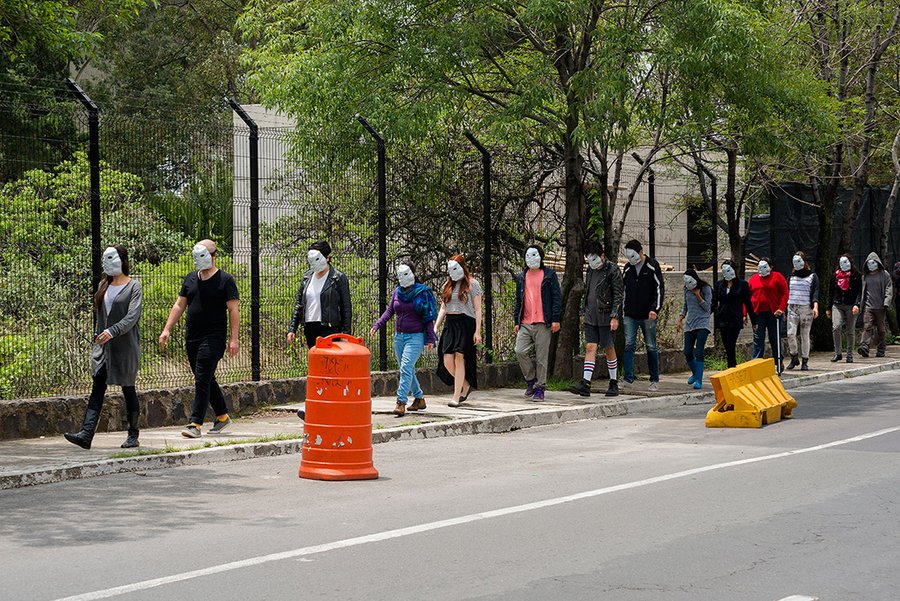
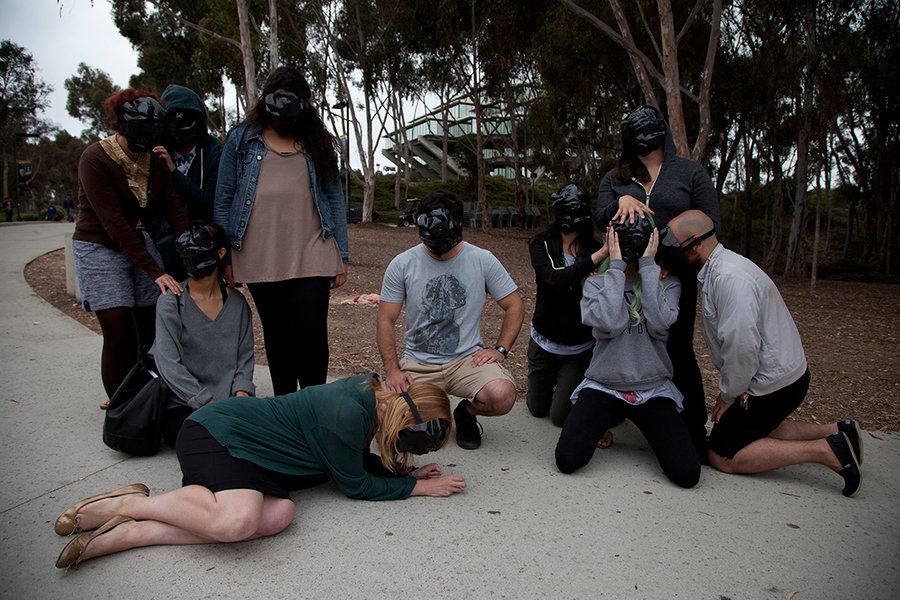

Examples of the use of masks designed by Zach Blasom, photos 2013-2014.